Por Communication March 5, 2021
The almond tree belongs to the genus Prunus, and given its close relationship with other species of the same genus, such as plum, apricot, and peach, it can hybridize with them, producing fertile offspring. To determine pruning the almond tree into a hedge Ideally, we must not forget the most important concepts of pruning in modern fruit growing.
Almond tree pruning: techniques
We can differentiate between training pruning (during the juvenile period, as the tree structure is formed) and maintenance pruning (during the plant's productive period, starting from its first harvest).
- If an almond tree were left unpruned and allowed to grow freely, it would soon produce only in the upper parts and its productivity will quickly decrease. The lack of light would affect the shaded branches, preventing the May flower clusters from forming and defoliating those branches.
- The almond tree is a species demanding in lightIf properly pruned, it increases light penetration, reduces the risk of fungal diseases, and produces more carbohydrates or assimilates that directly influence the floral induction of the following season.
- In the almond tree there is competition for these assimilates among the leaves and fruitIf there is too much vegetative growth, it is normal to have lower production.
He almond tree It produces its fruit (almonds) in the flower budsAll the buds are located along the branch in the leaf axils, hence the name axillary, except for the one at the very end, which is called terminal or apical. Beneath each leaf are these lateral or axillary buds, flanked by two smaller buds called stipulars. If these develop into flowers, their size becomes equivalent to that of the central bud. The buds that have developed into flower buds are called flower buds or buttons.
Flower buds are produced by floral induction and initiation from lateral buds of the current vegetation. The flowers that appear in a given spring have always been produced by the development of lateral buds on the branches that grew the previous summer. This varying capacity and tendency of lateral buds to develop into flowers is a characteristic of each variety, which can change with age and external climate and growing conditions. Normally, each bud gives rise to a single flower when it opens, but in certain varieties, a proportion of buds open into two flowers, as is often the case with the 'Tuono', 'Guara', and other varieties, which will have twin almonds.
Types of almond buds
Before getting into the topic of pruning almond hedges, it is worth reviewing the different types of buds that exist and in which organs they are found:
- Apical bud: always vegetative (never flowering).
- Axillary bud: They can produce leaves and flowers, differentiating between different types of bouquets (those that produce only leaves or those that produce leaves and flowers), we can simplify them to 5 types:
- Wooden bouquet: no flowers, only leaves.
- Pacifiers: if the wood shoot comes from a vigorous branch, causing vertical sprouting, with great vigor, long internodes and no flowers.
- Mixed bouquet: provides flowers and leaves. ―Brindilla: is a mixed bouquet of short length (<25 cm) flower buds predominate except for the basal and terminal buds.
- May BouquetIf growth is even less than a chiffon, all lateral buds are flower buds, internode length is practically nonexistent.
- Pre-arranged bouquetSometimes, when a branch is in a phase of rapid growth, some of the lateral vegetative buds also begin to grow, giving rise to branches that sprout from a lateral bud of another branch that has grown previously in the same vegetative period.
Pruning the almond tree in a super-intensive system
The secret to pruning almond trees is achieving the best balance between the wooden formations which will provide the necessary carbohydrates for all the plant's processes and the flower-bearing formationsMay bouquets and toasts are the most interesting.
Once these general principles for the almond tree have been explained, we are now in a position to talk about the pruning of the super-intensive almond tree. We will address this through 3 small sections: main objective, dimensions of the hedge and pruning or topping protocol.
Main objective
Create a hedge that is a network of low-vigor branches (thin, short, and with a slight horizontal tendency). This will result in a large number of mixed shoots, twigs, and May bouquets, which will produce a high number of flowers per unit volume of hedge.
Hedge dimensions
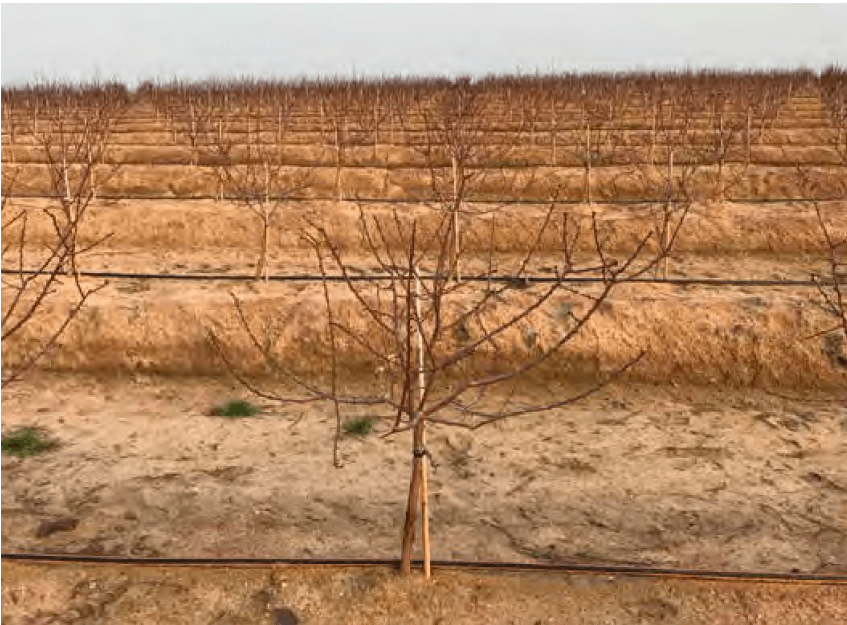
The height of the cross is defined by the format of the plant used (smarttree), this being approximately 45 cm from ground level.
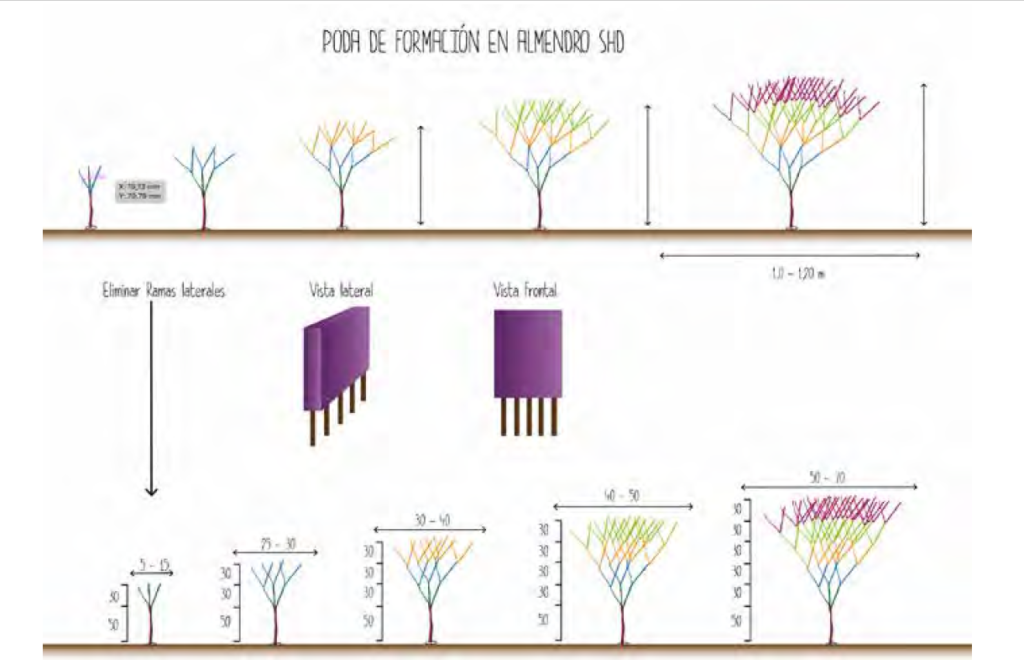
Once the hedge formationTypically, after three leaves or growing seasons, the final dimensions should be 2.6-2.8 m in height by 0.75 m in width. These dimensions are determined by ensuring no dark areas are left in the hedge, creating a highly efficient hedge capable of supporting flowers on virtually every branch by fully developing photosynthesis, and with sufficient light for optimal flower induction.
Pruning or Trimming Protocol
Training pruning
He Smarttree® This plant comes from the nursery with its tips already pruned. Once planted, you will observe the growth of the numerous branches. When these reach a length of about 30 cm, you should prune them, thus slowing their growth and redirecting it towards branches with lateral growth and those developing in the direction of the planting line. The aim is to prune the branches, generating new shoots just below the cut. These emerging shoots, having a less vertical orientation and a smaller thickness, will contain buds with greater floral induction (in short, they will generate twigs susceptible to flowering). produce almonds).
This trimming must be done 8-10 cm below the tip of each branch to be cutIt is not advisable to cut a branch section that represents more than a third of its length, as this could stress the plant, leading to a temporary halt in growth. The tree's growth pattern is globular due to its multiple growth points. Height growth slows compared to a centrally trained hedge, while the space between trees fills with vegetation more quickly because of the greater number of growing lateral branches. Due to this slower height growth, the center of gravity The trees are shorter, increasing their wind resistance. Lateral pruning is carried out mechanically to encourage branch growth towards:
- The topgaining height from the vegetative wall.
- The space between almond trees should be reduced, closing it and preventing the tree from becoming too rounded. Vertical growth should also be pruned back every 30 cm, as previously mentioned, avoiding very vigorous branches and promoting... emission of new lateral branchesThe initial pruning should be done manually to avoid leaving any branches uncut. Later, mechanized topping can be performed to encourage branching and slow vertical growth. Lateral pruning is simple and doesn't require a significant time investment per hectare (1–1.5 hours). This pruning creates a narrow, vertical wall of vegetation, with a width that will gradually increase from 50 cm to 70 cm, which can be considered the maximum width of the hedge. Lateral pruning should be carried out on both sides. The frequency of this pruning will depend on the growth rate, which in turn depends on the variety, soil type, water, fertilizers, etc.
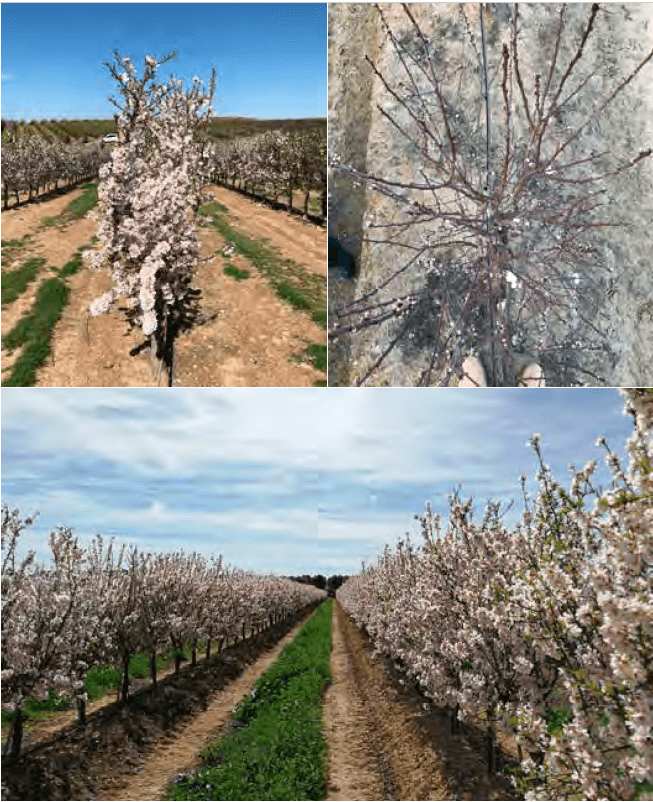
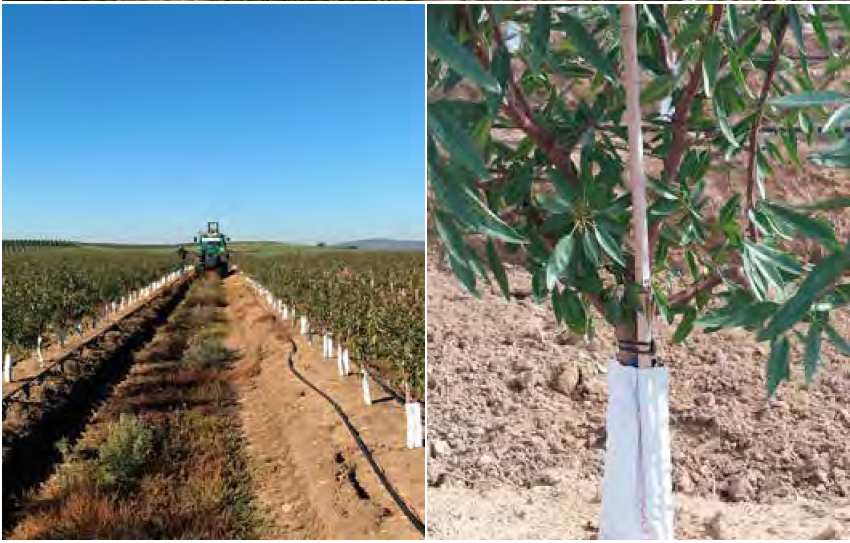
Once the productive wall height of 2.6–2.8 m is reached, the formation phase should be considered complete and the next phase should begin. production phase with mechanical lateral pruning. The resulting hedge is characterized by its lack of structure and any predominant central axis. These prunings should be done while the plants are still green, as this will result in less vigorous and less vertical lateral growth, making them more likely to produce flowers.
Production or maintenance pruning
Once formed the vegetation hedgePruning during the productive period basically aims to achieve the following objectives:
- Maintain an efficient and active exposed leaf surface to develop maximum productive potential.
- Achieving a balanced equilibrium between vegetative growth and production.
- Facilitate the work of the straddle harvesting machines.
With pruning you should the width be adjusted This vegetation hedge should extend no more than 35 cm on either side of the almond tree's central axis. This will improve the hedge's light and air circulation, creating a microclimate that promotes fruiting, disease resistance, the renewal of productive buds, and the orchard's energy balance. If the hedge is too wide, it will gradually develop an aged, photosynthetically inactive structure within the hedge, reducing the orchard's productive efficiency.
We will be able to practice this task after harvestWell into autumn, when the trees have finished photosynthesizing and have built up sufficient reserves for the next flowering, coinciding with the loss of leaves, it will be done on all sides, to maintain a width of 70 cm.
All these concepts are complemented by the use of Rootpac-20 rootstockThis variety provides little vigor, especially after the first harvest, once the juvenile phase (3 leaves) has passed, resulting in a very balanced hedge with little tendency towards vigorous growth but a high production capacity. The higher density of fruit per cubic meter of hedge is the basis of the most efficient system available for almond production.
Source of the news: Agromillora
 EN
EN  ES
ES  PT
PT  FR
FR