Por Communication February 9, 2021
The nutritional monitoring service integrates monitoring during the season of the Water-Soil-Plant system in different phenological stages of the crop.
The service is based on monitoring irrigation water, fertilizer solution, soil solution, foliar and fruit dynamics, as well as providing technical assistance from agronomists specializing in plant nutrition. This way, producers receive timely and easily accessible information, clear and accurate diagnoses, and practical recommendations tailored to their specific needs.
The following describes each of the analyses involved and their importance for the crops:
Soil System – Soil Solution:
The soil is a system composed of three phases of great importance: solid, gaseous, and liquid phases. It is in the solid phase where organic matter and soil particles interactThese factors determine the texture and potential fertility of a soil. The pore space gives rise to the gaseous phase, where the exchange between CO2 produced by the roots and O2 from the atmosphere occurs. During irrigation, the porosity begins to saturate with water, resulting in what is known as the liquid phase, which keeps the nutrients in solution. (soil solution; Figure 1).
Figure 1.
Diagram of the complex soil-soil-root interaction system.
Modified from 2005 Pearson Education, Inc. Published as Pearson Benjamin
Cummings. All rights reserved.
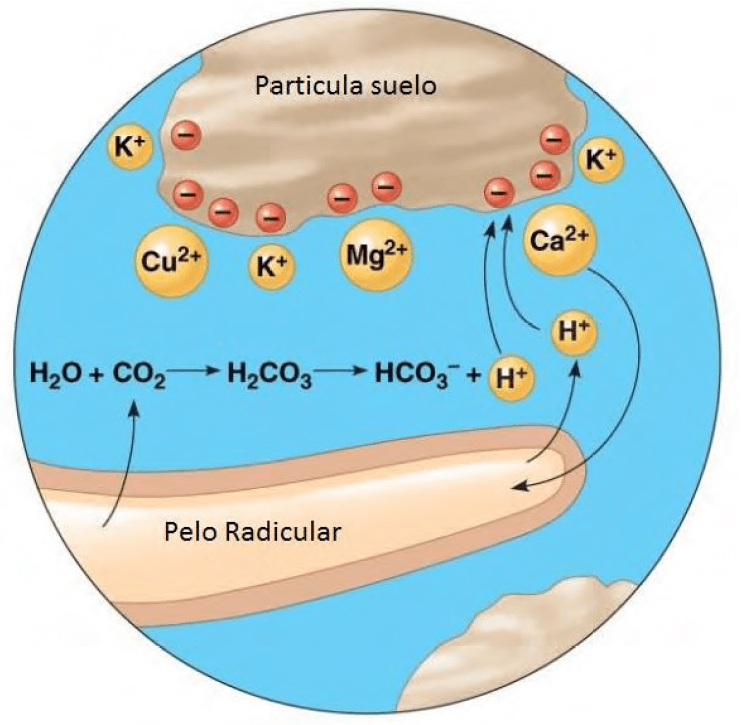
The soil solution is a highly relevant dynamic parameter, as it constitutes the transport medium for the inorganic or ionic forms of nutrients, and it must meet the specific requirements of a crop and its phenology. Roots respire continuously and release significant amounts of CO2, which, in contact with soil water, is converted into carbonic acid (H2O + CO2 = H2CO3), which rapidly dissociates into hydrogen and bicarbonate (H+ + HCO3)H+ ions diffuse towards soil particles and readily displace other cations bound to exchange positions, such as potassium and sodium (K+ and Na+ respectively).
In this way, The cations initially adsorbed to the soil are exchanged with H+ and pass into the soil solutionwhere they can be absorbed by the roots. This generates an ion exchange phenomenon between the soil and the crop. Exogenous applications of fertilizers to the soil alter the properties of the soil solution and the nutrients available for absorption. However, a fraction of the applied nutrients can pass directly into the exchange complex of the soil particles, while another fraction can leach into the soil. In both scenarios, the efficiency of fertilization decreases.
Factors that regulate ion absorption include:
Soil aeration
Temperature
pH of the soil solution
Synergisms/antagonisms
Electrical conductivity
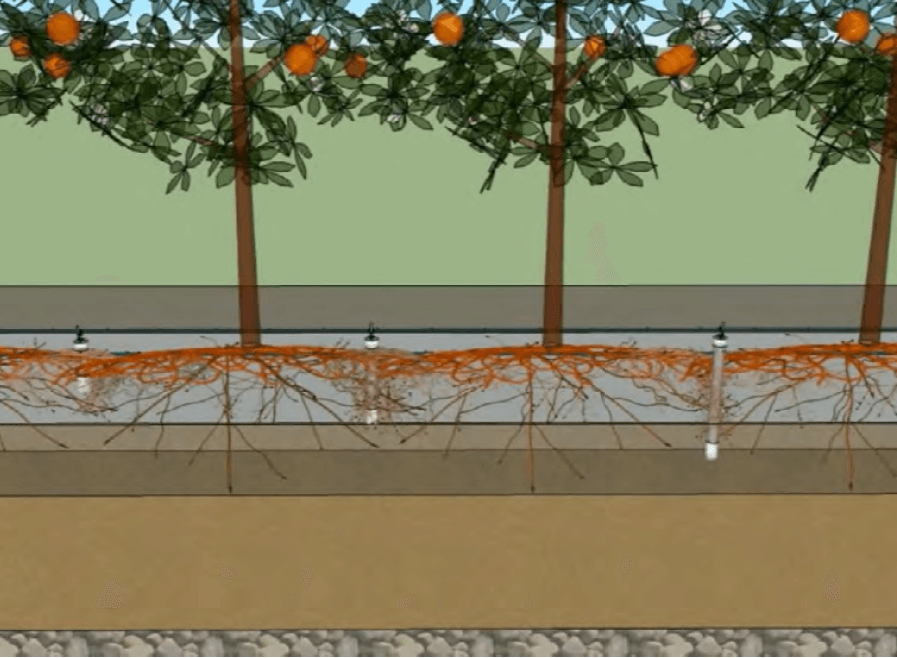
Figure 2. Diagram of the location of lysimetric soil solution suction probes at different depths of the profile.
As the concentration of a specific ion in the soil solution increases, so does the probability
of absorption, which is particularly relevant for those ions whose absorption mechanism is diffusion.
However, Absorption is compromised when the total amount of dissolved salts exceeds a threshold determined by the culture. (osmotic potential or electrical conductivity of the soil solution).
Finally, the ions dissolved in the soil solution enter the roots of the plants through two absorption processes, related to energy expenditure: passive or active absorption. Within passive absorption (without energy expenditure) Mass flow is prominent, while active transport occurs against a concentration gradient and requires energy expenditure for specific transporters or “carriers”.
The lack of information and tools that would allow for an adequate diagnosis of the nutritional status of the plant in the field for the development of fertilization programs leads, in most cases, to cases to the use of plans established by “literature”Recommended by neighbors, or through years of trial and error. All practices that generally do not consider the conditions of each plot or the productive reality. The very high variability that we can find within the same farm means that a fertilization plan works very differently depending on the type of soil, variety, climatic condition and management, and even during seasons.
This leads to inefficient fertilization, a progressive decrease in yield and quality, and a constant impact on soil characteristics. Soil and foliar analyses help to develop or correct fertilization plans, but in most cases they do not allow for an evaluation and monitoring of the same. It is not possible with just one analysis in the season to know what happens to the nutrients once they are supplied via irrigation in each phenological stage, how much is absorbed by the roots and how much is lost due to inefficiency.
They also don't tell us how and when to fertilize, nor how to react in time to excesses or deficiencies. In fact, many times we don't even have the right person to carry out a correct interpretation, which makes achieving our production goals and objectives even more unlikely. The methodology established by AGQ Labs allows for the diagnosis of nutrient dynamics in the soil solution during the various highly relevant phenological stages, and for this purpose lysimetric suction probes are used, which allow us to obtain soil solution from the profile.
With the samples obtained from the probes, an analytical process is carried out in the laboratory, which allows us to obtain information regarding the availability of different ions for the plant (Figure 2).
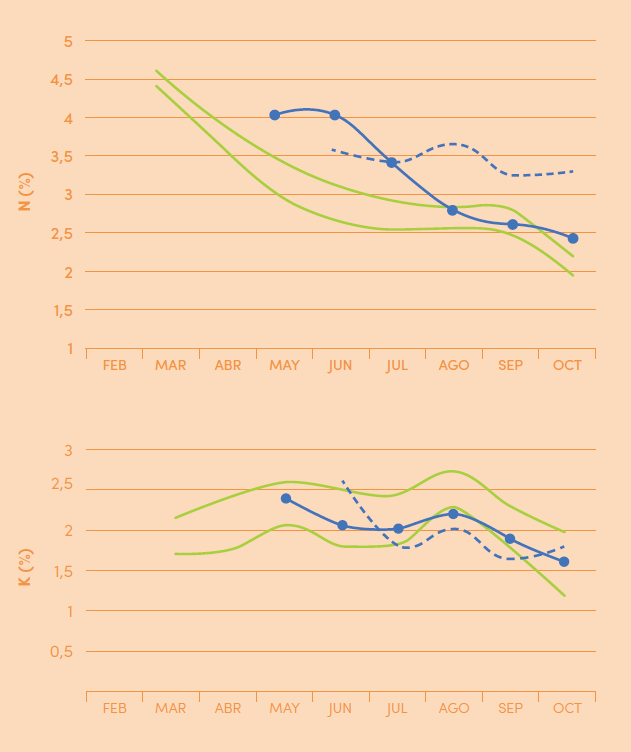
Figure 3. Example of foliar dynamics for Nitrogen (top) and Potassium (bottom) for Almond.
Fertilizer Solution for Irrigation
The fertilizer solution analysis is obtained directly from the emitter outlet (dripper or micro-sprinkler) and provides information about the nutrient solution entering the system after the fertilizers have been injected.
This information andIt is possible to control that each nutrient is provided in the correct form and dose, as well as including them in appropriate proportions to avoid competition.
This solution The fertilizer penetrates the soil profile and begins to react with the soil.The soil, depending on its cation exchange capacity, will contribute cations to the solution and remove others. Furthermore, the root system, which absorbs from this soil solution, will also remove a quantity of salts and water depending on its activity, age, phenological stage, and environmental conditions. The remaining fraction of the fertilizer solution will be leached through the soil profile.
Foliar Dynamics and Fruits
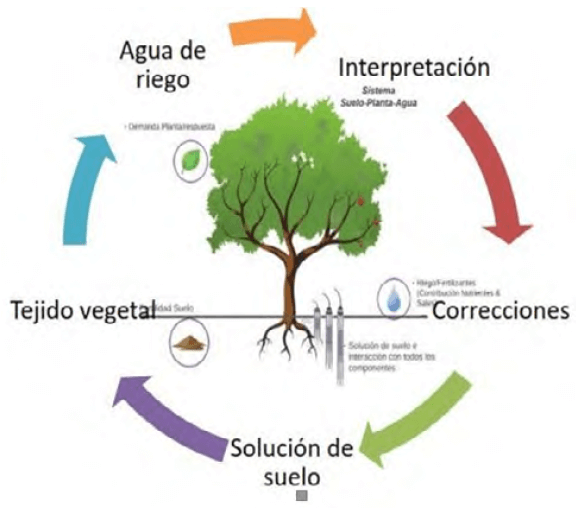
Figure 4. Cyclical diagram of the soil-water-plant system audit.
The information obtained from soil, irrigation water, soil solution, and fertilizer solution analyses is fundamental for comprehensive system management. However, This information is meaningless if it is not complemented with data from the crop, since ultimately our main objective is to generate a positive effect on the plant. To complement the nutritional monitoring service, each sampling time incorporates tissue, leaf and fruit analysis as appropriate.
Foliar dynamics allow us to evaluate the plant's response to our nutritional management. It also allows us to observe tissue-level trends and anticipate potential problems or nutritional deficiencies. To this end, AGQ Labs has developed foliar reference curves for the entire crop cycle, considering historical data from various producers and agricultural companies across the country. (Figure 3).
The methodology established by AGQ Labs allows for the diagnosis of nutrient dynamics in the soil solution during highly relevant phenological stages.This information is supplemented with analytical data on irrigation water, fertilizer solutions, and tissue dynamics (leaves and fruit). This data allows for maximizing fertilization efficiency and continuously monitoring the soil-water-plant system. (Figure 4)to increase the yield and quality of the final product, as well as the profitability of the crop. Among the benefits of the system, we highlight:
-
It makes it possible to determine the actual nutritional needs of the crop.
-
It allows for the timely correction of nutritional deficiencies or excesses.
-
It is advisable to establish fertilization plans based on the actual needs of the crop, thus avoiding over-fertilization.
-
It facilitates the development of strategies to combat salinity conditions in soil, based on synergisms and antagonism of ions in solution.
-
It makes it possible to evaluate the efficiency of fertilization and the use of nutrients.
-
It positively affects the productivity of the plots, potentially generating better fruit sizes, color, soluble solids concentration, firmness, among other qualities.
-
It generates savings by reducing fertilization plans, as it considers all sources that provide nutrients.
-
Technical assistance throughout the entire period of nutritional monitoring.
 EN
EN  ES
ES  PT
PT  FR
FR