Por Agroingex Administrator October 13, 2021
Who is Luis Miguel Delgado?
What led him to become involved in agriculture?
I have a very close connection to agriculture; I'm an agricultural engineer, and my father is a farm foreman. He started a distribution and crop protection company called Semillas Delgado.
One of my most cherished memories was finishing high school and moving to Córdoba to study. Once there, I experienced olive groves firsthand; Córdoba is wonderful. Honestly, we had a great time during my studies, and the education we received was quite good.
For my final year project, I went to Albacete with a very good technician named Vicente Bodas. With Bodas, we looked at all the extensive crops. He had approximately 400 hectares of farmland, and we based our final year project on the entire farm's work plan, crop rotation, profitability, economic plan, investment, etc.
With my final year project completed, I returned home. My father's company was still growing, and I saw it as a good time for new opportunities. At that time, Óscar de Marcos and I founded Sociedad de Gestión de Fincas Rústicas (Rural Estate Management Company) in Talavera de la Reina. We specialize in advising farms and ranches, not only on agricultural matters but also on all administrative aspects, such as subsidies and the Common Agricultural Policy (CAP). We help businesses comply with the requirements and regulations to obtain the maximum possible subsidies.
How do you think you got here?
We've come this far because of the need to find new opportunities. Here in the area where we've grown up, there have always been large cereal farms owned by people from Madrid. The farmers don't own the land, which is why there hasn't been much progress. The companies or the owners just want to keep the farm running at the lowest possible cost. One of our fundamental ideas is to invest in something new. For example, Toledo has many recreational and hunting estates; the irrigated farms there are very traditional and focus on maintaining their corn and cereal crops, thus ensuring a certain level of profitability.
Managing and advising olive groves, and with the idea of diversifying, we came across Agromillora. When they started their journey with hedgerow almond trees, it caught our attention.
It was something new, a system with interesting possibilities, and we took the leap to managing almond orchards in hedgerows that we were advising.
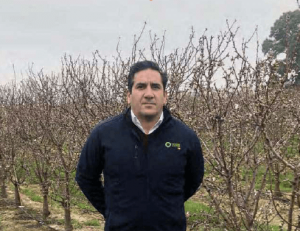
Luis Miguel Delgado
What would you say is the added value of Sociedad de Gestión de Fincas Rústicas?
Technology and training. In the end, what's really important is the know-how; if we know how to grow almond trees in hedgerows, that's the idea we convey: how to do it without making mistakes.
This, for us, is the most important thing. Investors must understand that they shouldn't put themselves in the hands of unprepared people. We know of many farms in the province of Toledo that have embarked on very large-scale operations and have failed. A lot of money has been invested, and it's all gone wrong; that's precisely what must be avoided.
What do you value in a partner like Agromillora?
They are the ones who have provided that information, who have helped contribute the know-how that we have gradually acquired, and we have done it together with them. We have learned how to prune, what fertilizer to use, what treatments to apply, the phases of the almond tree, the amount of nitrogen, phosphorus, and water, disease control…
What is your area of influence? And how many plantations are you working with?
Our area of influence is Toledo and part of Extremadura. We always seek out the mildest climates. We currently manage more than 10 farms. We oversee over 500 hectares of hedgerow almond orchards, and we have projects underway in the short term.
Speaking of projects you're working on?
This year we've undertaken a significant project: a plantation of approximately 120 hectares. We're also reducing the planting density, which was previously 3.5 meters. We're going to reduce it to 3.1 meters to increase the amount of foliage and thus achieve higher yields. This reduction from 3.5 meters to 3.1 meters is accompanied by a spacing of 1.25 meters between trees.
What difference do you find between a traditional plantation and a hedgerow?
Advantages, especially with the start of production. In one plantation, two and a half years old, for example, we obtained 1250kg. We had some of the Penta variety that froze and reduced our production, but the Soleta variety has achieved very good flowering and production this year.
Another important difference is the personnel. In the first and second years, the SES or hedgerow system requires staff because you have to train and prune the trees. Even if this pruning is done mechanically, you still have to check the lower branches, especially the branches; they need to be raised. We've noticed that in the first plantings where we didn't check the lower branches, we had problems when we went to harvest because the almonds were falling off the branches and out of the harvester. There are a number of tasks that require personnel, but the same is true for conventional almond trees. The advantage is the mechanized training pruning, which isn't very technical. The operator has to follow guidelines to create tiers of less than 20 cm. From the third tier onward, we can increase the spacing to 30 or 35 cm.
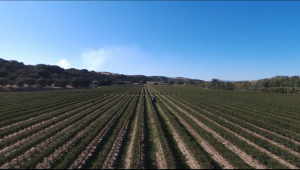
Almond orchard in Talavera de la Reina, Toledo.
"Always trying to reduce the width of the wall so that when it reaches its final height we have a hedge no more than 80 centimeters wide"
We're always trying to reduce the wall's width so that when it grows, we'll have our target of 80 cm. We have a plantation that's four years old and in its second year of production. It's about 2.20 m tall and is approaching a ceiling we've set of 2.80 m.
The plantations we've seen in intensive cultivation are very tall trees, 5 or 6 years old, but tomorrow, when they reach 5 or 7 meters in height, the treatment efficiency will be much lower than with a hedgerow. I also believe that reducing water consumption will be important in the future. Water density is lower in a hedgerow than in an intensive plantation.
The incorporation of almond trees in hedgerows in dryland farming
It has potential in cooler areas; here in Toledo, the soils are very short and sandy, drying out quickly, so it's not a particularly interesting area. The La Sagra and La Mancha regions, towards Cuenca, are interesting areas, with cool soils that retain moisture well.
How do you see the almond market?
The outlook is that everything produced is consumed. Therefore, in the short term, it's unbeatable. In the long term… in Spain we can reach 350,000 tons; we're currently at 70,000.
Given that the United States has over a million customers, we have some influence, but not as much as the American market. However, it benefits us that they control the price.
It's an advantage we have to take advantage of. Even though there's a lot of production and we're projected to reach 350,000 tons in the future—we're currently at 70,000—next year we can reach 100,000. I think we're going to surpass Australia in production next year.
Besides almond trees, what other crops do you work with?
Pistachios are a great crop to complement almond investments. Here in Toledo, very large pistachio plantations are being established; some farms already have 250 hectares of pistachio trees within a single area. It's an area with excellent conditions for pistachio cultivation. We also manage pistachio plantations.
The goal is to diversify and establish almond and pistachio plantations. The prospects for pistachios are very promising, even more so than for almonds.
 EN
EN  ES
ES  PT
PT  FR
FR